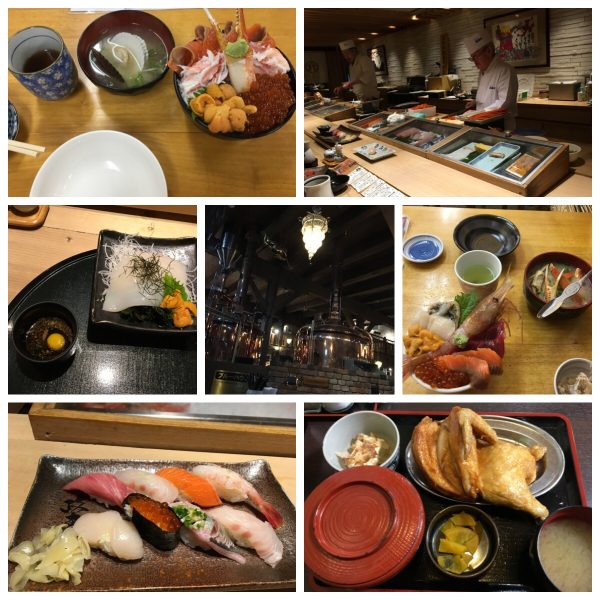
In this article, I want to introduce good places to eat in Otaru city.
Today, I am writing based on this article from my Japanese blog which I wrote this year.
Where is Otaru? It’s one of the cities in Hokkaido!
Otaru is a city 1 hour away by train from Sapporo which is the capital of Hokkaido.
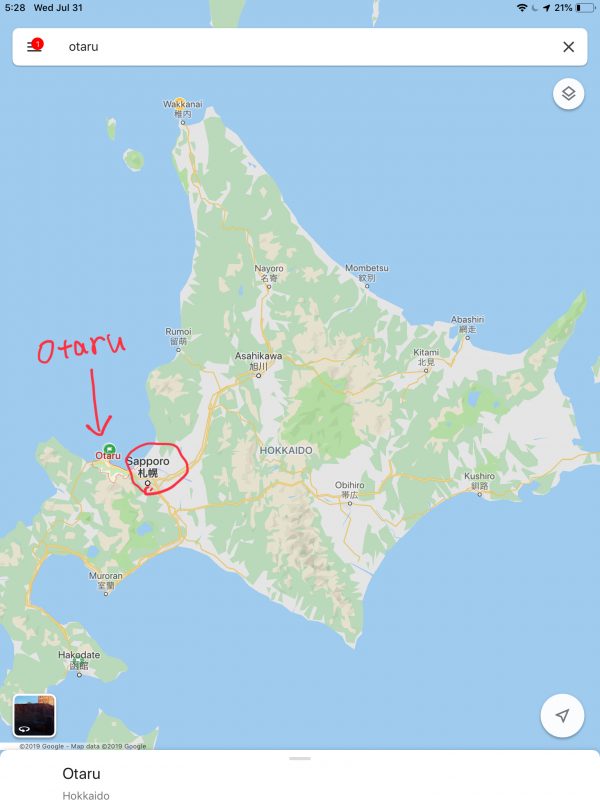
Since it’s located by sea, it developed as one of port cities in Hokkaido.
Therefore, Otaru has a somewhat Western atmosphere a little like Hakodate (the biggest port city in Hokkaido and one of the major port cities in Japan).
This is the Canal Otaru. I have visited there in both winter and summer.

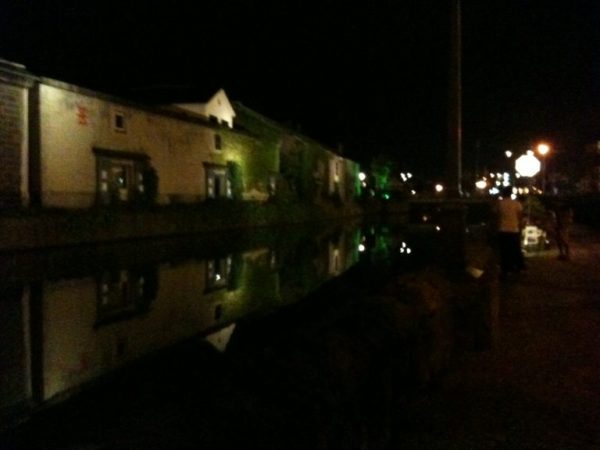
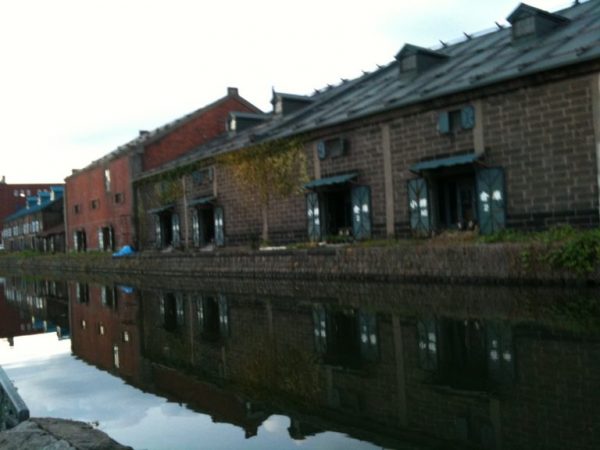
I will write about my experience exploring this city on another post.
Otaru Masa Zushi – you can have a decent set course meal for a reasonable price.
Yes, Hokkaido is the place for extremely fresh seafoods, especially in seaport cities like Otaru!
There are two main types of places to eat sushi, a traditional sushi bar and ‘kaiten-sushi’.
 I was here in late January this year.
“a traditional Sushi bar”, we call it “Mawaranai O-sushi” that means “Sushi which does not go round (on a belt conveyor)”. Dining out at a traditional sushi place is special because it is generally much more expensive than Kaiten-zushi (conveyor belt sushi restaurants). By the way, Kaiten-zushi places also have an excellent reputation for tourists in Hokkaido. Many people say “It’s not necessary to spend much money on “Mawaranai O-sushi” in Hokkaido. The quality of Kaiten-zushi is even better than middle ranked traditional bars in Tokyo”.
However, if you visit Otaru, I want to recommend you to experience a traditional one because that will be one of the highlights of your stay.
Your budget is limited? Don’t worry, now I will introduce you to a decent traditional bar that is not too expensive, “Masa Zushi”.
It was located alongside the street.
It looked very traditional.


This is the reception area with some chairs. Somehow they thought I was a foreigner (There were 10 times more Chinese speaking tourists than Japanese tourists in Hokkaido…), so the receptionist said to me “Please wait” in English.
A few minutes later, I was escorted inside, and finally I had a chance to say “Nihonjin-desu (I’m Japanese)” to a waitress.
I had a seat at the bar because I was alone. Actually, even if you are not alone, it will be better to have a bar seat because the chef can prepare sushi watching your eating pace.


I guess he was a Taisho (main chef).
I ordered a “Masa Zushi set” that costs 3,500 JPY (app. $33/€29).
The first dish was “Ika Somen” that literally means “calamari noodles”, but it is actually sashimi of calamari (squid) which is cut into fine strips. The shape is similar to somen type noodles, this is how it gets it’s name.
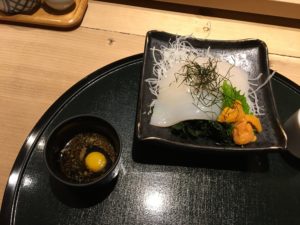
 The interesting point was the sauce. It was served with raw egg (in Japan, the eggs are safe) and sea urchin, and I mixed them together rght before dipping the sashimi of calamari into it. I am a big fan of sea urchin, and I was surprised to learn this way of eating it, but the taste of it as a sauce, was really mellow and a good combination with the fresh sashimi of squid.
 The Tofu salad.
 This is Iwa-nori soup (rock seaweed), it warmed me up after walking in the snow.
And finally the sushi set was served! Medium-fat Bluefin Tuna belly, white fish, Alaskan pink shrimp, salmon, scallop, salmon roe, horse mackerel and another white fish.

Basically, 7 pieces are served in this course (Masa Zushi set), but I happened to find a coupon to get one more piece…and that should be the white fish.
Every piece was fresh and thick. It was a really good deal to have the set just for 3,500 JPY in this quiet and authentic sushi bar.
And I was so impressed by the Ika-Somen.
Kaisendon in Sankaku market
When I was living in Europe, I often dreamed of Kaisen-don.
**** -don is the bowl (“Donburi” in Japanese language) of rice topped with something. Kaisen means seafood so, Kaisendon is a bowl of rice topped with sashimi.
Actually, the main purpose of visiting Hokkaido was to eat Kaisendon made with very fresh sashimi.
I read through a lot of reviews about canteens there before traveling, and I chose 2 places in the Sankaku market.
 That is the Otaru station, and you can find the Sankaku market on your right.

 What attracted my attention was the door. Usually these type of markets are open air in Japan, but here, this door prevents freezing air from blowing into the market.
Takinami – the highest satisfaction scores
According to the reviews on Google or Japanese restaurants review sites, this diner gained the highest satisfaction scores.
I arrived in Otaru in late afternoon and after check-in at my hotel, I was rushing to the diner at 1630, because the info showed its closing time is 17:00. But I found out that the closing time for them was “the deadline of entering”, so some customers were allowed to have a table right up to that time. Actually I had got used to the European habit, I got shot down many times when I tried to enter shops or supermarkets 10 minutes before the closing time.
Anyway, “Takinami” is a vendor shop in the market and they manage a diner too.


This is the entrance. Many reviewers claimed there was always a long queue, but luckily I got a table immediately.
 What you can expect is so clear by the pictures of the dishes….

This is how the inside looked. When I was here, there were more other Asian tourists than Japanese. Not only in Otaru, but Sapporo also had more foreign tourists, so the ratio of languages I heard in Hokkaido was like; Chinese (60%), Korean (15%), and Japanese and Thai are almost the same (honestly these numbers are not exact because I cannot tell Cantonese from Mandarin, etc. It was just an educated guess in some cases. I saw some people holding a guidebook written in Thai, so I realised where they were from.
Why Hokkaido is so popular among them? I wrote my thoughts here.
Japan is not a very English-friendly country, so I don’t think the employees speak English, but don’t worry, you can easily find what you want to eat from the pictures of the dishes and just point it.

The picture menu was everywhere from the entrance to on the table.

At first, I was thinking of choosing “Wagamama (literally, ‘selfish’) -don” in which you can choose the 4 kinds of sashimi you favour.
But the waitress recommended “Takinami-don” saying it contains all of the popular fish. Every donburi comes with miso soup with seaweed for free, but I took her other recommendation to replace it with crab miso soup for an extra 300 JPY. (in total my meal cost 2300 JPY)

Here comes the “Takinami-don”. Yes full of fish on the bowl of rice. It’s hard to eat directly from the bowl, the waitress told me to use the black plate.
Tuna, Salmon, Salmon roe, spot prawn, sea urchin and scallop. 6 species. Surely it’s a good deal unless you are obsessed with just 1-2 species.
The rice is mixed with vinegar, like the sushi rice in this diner, but if you want normal rice, you can ask the waitress for that saying “Futsu- no gohan, please (Every Japanese recognises ‘please’)”.
 This is the crab soup, and as you can see, full of crabs there! I was struggling to take the flesh from the shell, so personally I recommend you to have the free soup unless you are a big fan of crab. You should focus more on your Donburi.
Takeda – ANA special don was delicious
I went back to the Sankaku market next day to visit Takeda, which is located next to Takinami. It’s also the diner which boasts high scores on the review site. It closes at 15:00, and I had a big breakfast at my hotel, so I entered there at 14:30.


There are several diners in the market, Takeda is the place with a yellow shop curtain with black writing. Inside the diner, there are lots of autographs of celebrities on the walls.
Here is the menu, every bowl looks fascinating, but since I am originally writing my Japanese blog as a loyal passenger to ANA (look at the address of this blog: actually the Japanese language blog gives advice on how best to reach frequent member status with ANA), ANA special-don was the only option for me. This dish was invented using the advice of ANA flight attendants (Japanese flight attendants are generally very foodie).

 After ordering the donburi, a waitress brought the dried calamari with ink as well as the tea (for free). I guess it goes well with Sake, or Shochu, a type of Japanese liquor.
So here is my ANA special-don ! (2300 JPY =app.$21/€19)

My donburi looked exact as rich as the picture on the menu! And it perfectly met my expectations. I could easily take the flesh from the crab’s claw and it was thick and tasty. Besides the crab, the salmon roe, sea urchin, and salmon were extremely fresh and delicious. The scallop soup was a part of the meal and I liked the mild flavour. Unlike Takinami, the rice at Takeda was not mixed with vinegar.
Personally, I prefered Takeda to Takinami
Although Takinami was more highly rated than Takeda, I personally preferred Takeda.
I guess Takinami opens 2 hours longer, and it may have worked on attracting more customers.
And after all, I prefer normal rice without vinegar for Kaisen-don, so this is just my personal preference.
If you have enough time, try both!
Otaru Soko (warehouse) No.1 – local beer with a nice view of the canal
I didn’t eat much here because I was not hungry at all, but I just felt like trying one of the places alongside the canal, and I chose here.
After walking along the canal, I went to the other side of the buildings, and then I decided to try this beer hall.


The menu was displayed at the entrance.
This is what the inside looked like.


There are many types of beer on the menu, basically brewed in the German style.

The foods here are also German, but I found some other European things like Terrine (French) or Carpaccio (Italian).
I could choose my seat but the window side bars were occupied, so I took here.

I chose Pilsnar for my first drink and Sauerkraut.
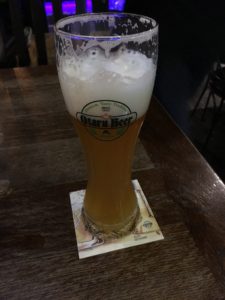 Waiss for my second drink, I liked its fruity taste.
The interesting point here is that you can see through into the brewery through glass windows.

Naruto – crispy and juicy fried chicken!
As a tourist, I paid much attention to the fresh seafood in Otaru, but this is a popular place for its fried chicken among locals as well as tourists.
According to the websites, there is always a long queue, but luckily I didn’t have to wait when I visited there after 14:00. I guess it’s better to avoid the time around noon.

They also serve many type of Japanese dishes including sushi, Kaisen-don and Ramen, but you should try the Fried chicken here.
I chose this meal. Fried chicken, tofu, miso-soup and rice.

My friend chose another type of fried chicken (Zangi) meal.
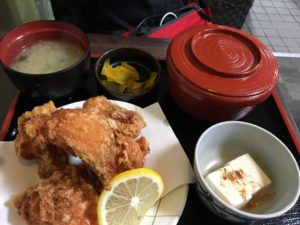
My impression was that it was very good! crispy, juicy, and tender.
My friend let me try one piece of her zangi, and honestly, it was not bad, but not so outstandingly good.
So I definitely recommend you to take my chicken (Hanmi-age) meal here!
Thanks for reading 🙂