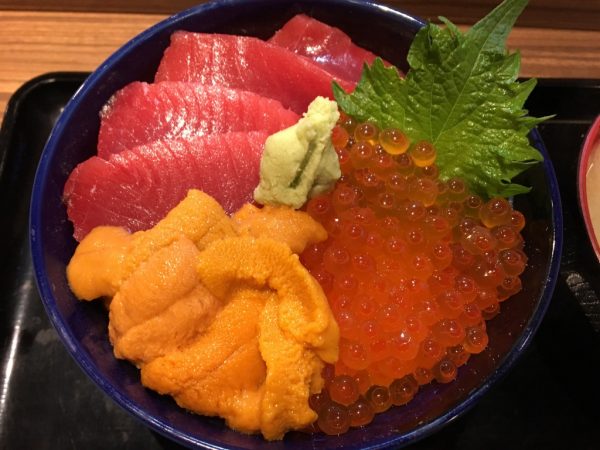
When I was living in Europe (England and Paris), I always dreamed of Kaisendon. Although sushi is now getting popular around there, I didn’t want to eat them often outside Japan.. honestly. If you want to get to the same level of Japan in Europe, the price is more than 3 times that of Japan! (But I sometimes ate “ITSU” in London, I think it’s rather reasonable in Europe)
Anyway, I flew to Hokkaido from Tokyo 3 times last year (Sorry, Greta! It was before I got to know your activity!) because I found super promotional tickets on the internet and I wanted to have my dream come true…I eat as much of Kaisendon as I want in Hokkaido. So I tried 2 shops in Otaru, 2 in Sapporo and 3 in Hakodate, meaning 7 diners in total.
- Hokkaido is big
- What is Kaisen-don?
- Otaru: The 2 most popular shops in ‘Sankaku’ Market just next to Otaru station
- Sapporo: Robata Ooiso and Hakodate Uni Murakami
- Hakodate: tried 2 shops of Donburi Yokocho and 2 other shops
- In conclusion: If you want to have the best quality of Kaisendon with cheaper prices, visit Hakodate.
Hokkaido is big
Japan consists of five main islands and countless tiny islands. The five main islands are Hokkaido, Honshu, Shikoku, Kyushu and Okinawa. Hokkaido is one prefecture, but it’s bigger than Kyushu that has 7 prefectures.
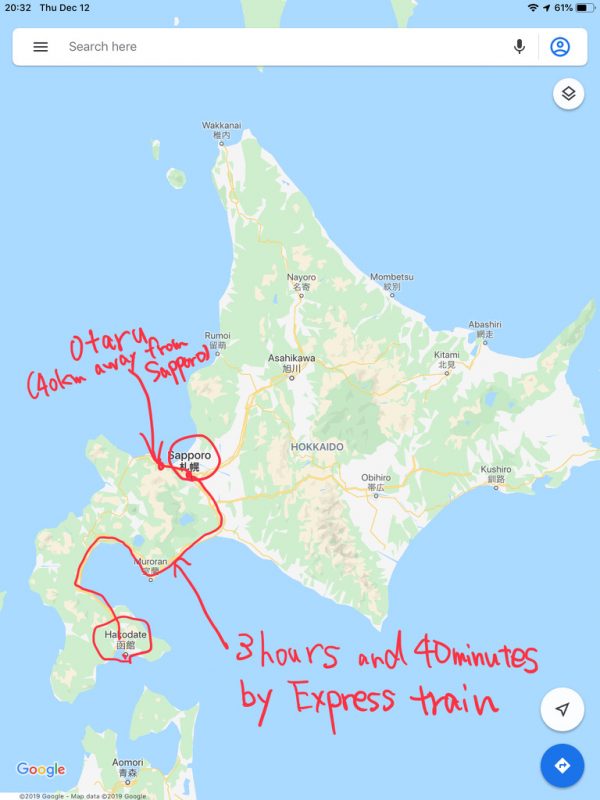
There are 14 airports in Hokkaido. Sapporo is the capital of Hokkaido and Hakodate is one of the 3 major port cities in Japan.
Otaru is rather small and only 40km away from Sapporo so it takes around 30 minutes by train to get there.
However, Hakodate is very far from Sapporo.
The most popular mode of transportation between those 2 cities is the express train called ‘Super Hokuto’, which takes 3 hours and 40 minutes.
You can also fly between those cities, it only takes 40 minutes.
I took the “Super Hokuto” to go to Sapporo after I stayed in Hakodate for 2 nights.

The point is, those 3 cities are not the same. Even though they are located in Hokkaido, they have quite different features. And even the seasons for certain kinds of fish are different.
So this time, I would like to compare Kaisendons in those three cities!
What is Kaisen-don?
Kaisen-don is a bowl of rice topped with fresh sashimis. ‘Kaisen’ means fresh seafood, and ‘don’, to be exact, is the abbreviation for Donburi which means Japanese bowl.
Gyu-don is a bowl of rice topped with simmered beef, and Ten-don is a bowl of rice topped with Tempura.
Originally, it’s not very posh. Topping rice with something was not seen as classy, but as the foods among laborers. Actually, it’s convenient for the people who need to eat up their meals during their break.
Although “***-don” is a casual style of dish, it’s also a good way to enjoy eating food as much as possible. Sashimi can be most delicious with rice.
Otaru: The 2 most popular shops in ‘Sankaku’ Market just next to Otaru station
When I was planning my trip to Otaru, I learnt about the 2 most popular shops in ‘Sankaku (means triangle) Market’, which is situated next to Otaru Station.

The building is Otaru Station.
Sankaku market is at the right side of the station. You can go up the stairs from the station to the market directly, but I went to another entrance of the market after checking in at my hotel.It was past 4 p.m. at the end of January.
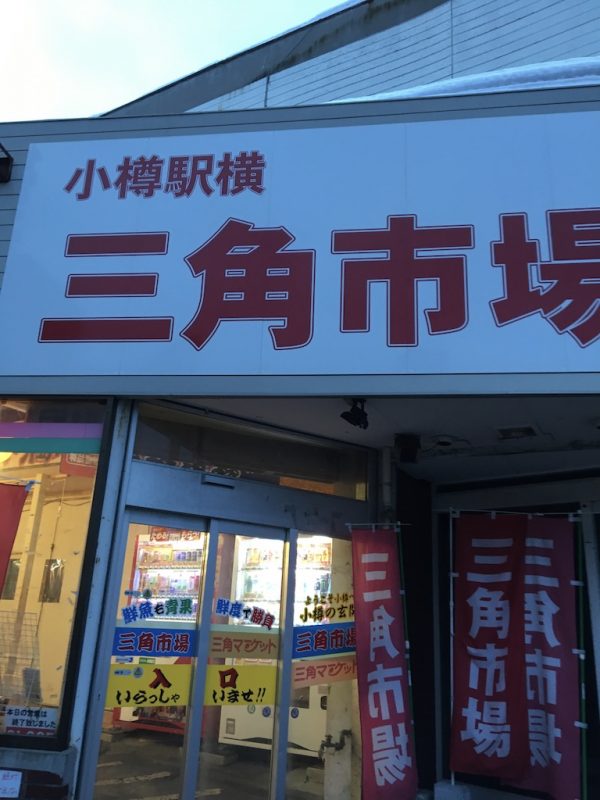
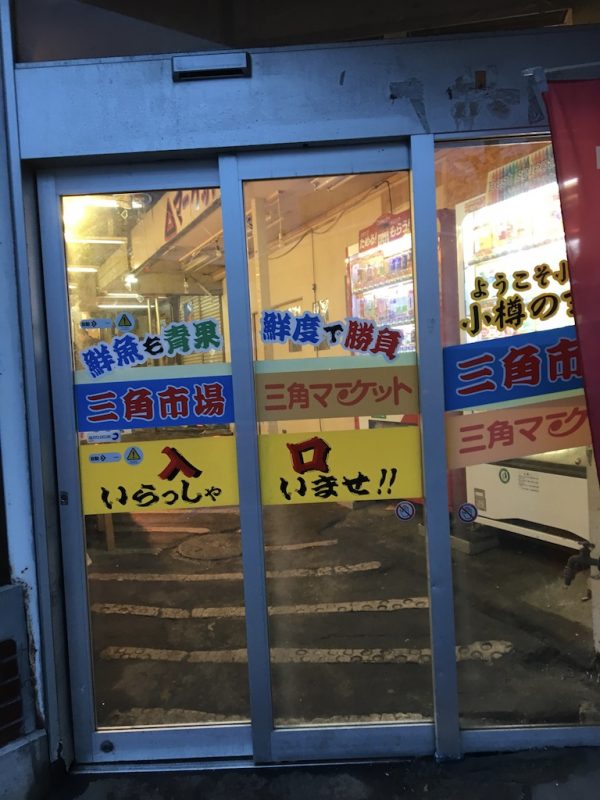
What impressed me is that the market has a door! Apparently they installed that in order to shut the freezing wind from the market.
Takinami and Takeda
I tried the shop because it won the most satisfactory scores on several review sites.
I have already written about those 2 shops in the following article, so please check it out!

I ordered ‘Takinami-don’ at Takinami.
2,300 JPY.

I ordered ‘ANA special-don’ as I am basically a writer about trips by ANA in my Japanese blog…
it cost 2,300 JPY as well.
Sapporo: Robata Ooiso and Hakodate Uni Murakami
In Sapporo, I also tried 2 places to eat Kaisen-don.
Robata Ooiso
At first, I just headed to ‘Ooiso’ which is located in Nijo Market after looking around Sapporo City.
It was highly evaluated on several review sites, and a shop of Kaisen-don in a fish market sounded “fresh and authentic” to me.
However, this kind of market generally closes early and it was sometimes blizzarding, so I had a bad feeling….


This is the ‘Ooiso’ I was originally aiming for.


After looking through the menu in front of the shop, I opened the door then heard the guy saying “I’m sorry, we are now closing!”. It was so disappointing because I saw the information about its opening hours on the internet and it was 1 hour before that.
But the guy told me, “There is another branch that is just a few minutes away, and all of the Kaisen-dons are the same as the ones here. ” So I followed his suggestion.
“Robata Ooiso” is rather an “Izakaya” style, but good options of Kaisendons
So, here is the place I eventually got to for my first kaisendon in Sapporo.

It is located just a few minutes walk from Nijo Market.


I immediately found an entirely different atmosphere from other restaurants in the market. Here, it’s completely an Izakaya (Japanese pubs) where you can enjoy drinking sake, beer, or varieties of alcohol with various selections of food…


Since I was a solo customer, a waiter offered me a counter seat, but there are “tatami spaces” for customers who come in groups. If you get a table in a tatami room, you need to take your shoes off.
Don’t worry, I remember there were some tables where you can keep wearing shoes, of course.

The menu the waiter handed to me was full of options, but I turned through the pages and went straight to the page of kaisendons.
Then the waiter found me staring at the page, so he brought the sheet of kaisendons to me.
Here, you don’t have to read any Japanese. You can find what you want to eat from the picture.

My choice was the assortment of tuna, sea urchin and Ikra (salmon roe), but I felt other options of the menus were fascinating.

This shop recommended Tsubu gai (The shell of whelk) on that day.
So, finally my dinner has come!

So beautiful. Its beauty indicates how fresh they are.

and…
I cannot say anything but simply
Delicious.
Unforgettably delicious.
Sometimes I feel like eating this thing in a rough canteen located in a fish market because the atmosphere makes me believe in the freshness of fish.
However, the kaisendon in this clean restaurant, whose background music was jazz was amazingly fresh.
The uni (sea urchin) was so creamy and rich, the ikura (salmon roe) was popping in my mouth, and the tuna!
I really recommend you to taste that by heart.
It was 3,500 JPY, not cheap, but it’s worth it.
Hakodate Uni Murakami (Sapporo branch)
I was so dreaming of uni (sea urchin) in Hokkaido. There is a famous and huge fish market in Tokyo, but usually uni in Tokyo is preserved with alums, so the taste has a bit of it.
Of course you can eat uni preserved in salty water in Tokyo, but it’s expensive.
Actually, I can never forget the uni I ate in Shakotan peninsula of Hokkaido in the summer of 2011. Since then, I have always dreamed of eating one again.
However, it was winter when I visited Hokkaido again in 2019, and it’s not the season of uni in most parts of Hokkaido. But it is uni season in Hakodate or the east side.
So, I wanted to try one in a famous place whose specialty is Uni-don, and since Hakodate was not included in my first round trip in Hokkaido, I went to a Sapporo branch of “Hakodate Uni Murakami”.
It was located in the Nihon Seimei building near the Sapporo station.


It was the beginning of February right before the Sapporo Snow Festival, so the front of the building was decorated with ice sculptures.
It’s on the underground.

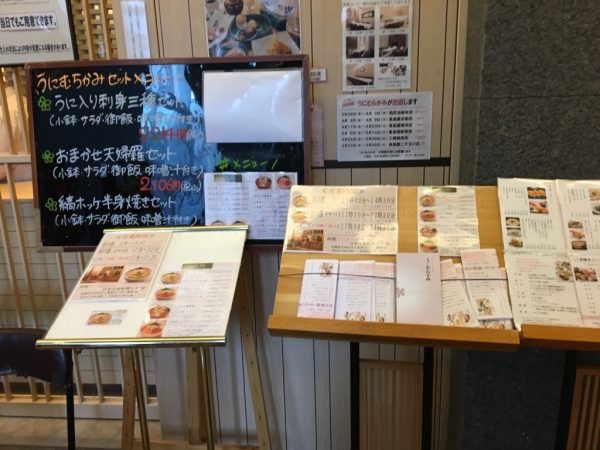
I heard that the last time to order for lunch is 13:45. It was 13:30 when I arrived there finding the sign “sold out”. I was about to give up, but one family that arrived after me negotiated with the manager and they were allowed to enter, so I also talked to him then got a seat. I saw some people who gave up because of the sign, so I think I was lucky but it rarely happens in Japan (Customers are usually fairly treated).
It looked a bit posh inside.


There are some options in the menu but this is an uni place, so I ordered the expensive Uni-don (4,000 JPY… around 37USD or 34€).

Here comes my Uni-don with miso soup and Japanese pickles!


This shiny uni! The looks shows its high quality! But the only disappointing thing is the Donburi (bowl) is so small.

At first, I tasted only the uni. Sweet. Creamy. Then, I tried it with rice. Amazing. Next, put the wasabi into the soy sauce to mix them then pour it onto the Uni (Do not spoil the fresh taste of uni by too much soy sauce!), Yes. Delicious indeed.
Yes, no doubt that it was a really good Uni-don.
However, 4,000 + VAT JPY was expensive for such a small bowl…
Honestly, the uni-don I had in Shakotan peninsula 8 years ago was way better. Considering it’s Sapporo and the season, it’s understandable…but I found it too expensive, anyways.

I thought the price was based on location (the building looked decent in the central Sapporo), but when I went back to Hokkaido one month later and found the main branch in the fish market of Hakodate, the appearance was exactly like the canteen in the fish market (rough, actually), but the price was the same.
Hakodate: tried 2 shops of Donburi Yokocho and 2 other shops
I visited Hokkaido again just one month after the previous visit to Sapporo and Otaru thanks to the ANA promotion (Significantly big earthquakes happened the previous year, so that’s a sort of a governmental campaign).
For my second visit to Hokkaido in 2019, I chose the land route to Hakodate and moved to Sapporo. It was my first time to visit Hakodate but it was one of my long time dream destinations, so my dream came true.

The building on the right side was the JR Hakodate station.

As soon as I arrived in Hakodate, I headed to a place called “Donburi-yokocho”.
Yokocho (横丁) actually means “an alley off main roads” which sounds nostalgic, let’s say, like the time after WW2 to the 60’s..
But this is not the real “yokocho”. It is just a modern establishment next to JR Hakodate station.

At the entrance, you can see the floor map with each shop’s panel.

I already had 2 shops in my mind. One was ‘Akebono’ which I had saw on TV and the other was “Chamu” which won the most satisfactory scores on a review site.
On the site, I found out those 2 shops are adjacent to each other.
Asaichino Ajidokoro “Chamu”
On the first day, I chose ‘Chamu’ over ‘Akebono’ because I was interested in the handwritten menu on the board “Special-don”.


There was a counter and some tables in the tatami space. We got a table after taking our shoes off but actually I cannot sit on my heels for a long time (not every Japanese person is comfortable with that!) , but I cannot do the “criss cross applesauce” in this country because I’m a woman. It’s quite bad for women to do that especially when wearing a skirt. But don’t worry, if you look completely “foreigner”, you are allowed. If your looks can be mistaken for a Japanese (you are Chinese, for example), just chat in your own language, and it should be ok…
Somehow Japanese women are not allowed…Anyway, I should have taken a seat at the counter!
They didn’t give us a menu but we had to choose one from the pasted menu on the wall. I am not so sure if they have an English menu or not, but I think they can manage if you don’t speak Japanese.(Hokkaido is familiar with tourists from other countries…especially that there are many Chinese tourists there)

A special thing in this place is these “appetizers”. They brought all of these small dishes for us (2 people).
I thought these are similar to the Korean style, but the dish thing is Japanese old style fisher meals–the salty squid, seaweed things, etc.
These things might be “too specific” for you to try. I think even young Japanese people don’t like some of these. And remember, you will have Donburi after this, so I don’t recommend you to eat up these dishes unless you are a big eater.
So my friend ordered this. “The Chamu set”. The ‘hair crab’ soup and the donburi of ikura (salmon roe) , red shrimp and tuna. She was so happy with the soup which had plenty of crab flesh.


And my donburi arrived!
Mine was the special-don of uni (sea urchin), ikura (salmon roe) and tuna. It came with normal miso soup. I remember there was an option of the hair crab soup for an additional cost.
I was impressed with such “fresh” colors! The red tuna was especially beautiful.


But I ordered an extra crab topping, so my friend immediately noticed my donburi did not have it. We informed the waitress about that so she brought it on another small plate.
So I topped my donburi with crab, and this is what I ate! I poured a bit of “soy sauce mixed with wasabi”.
And my impression was….the tuna was so delicious!!!
Needless to say, the uni and ikura were also delicious too, but the crab was so so…
My donburi cost 3,000 JPY (the special don was 2,300 JPY and the optional cost for the crab was 700 JPY), but the tuna donburi was 1600 JPY, so it might be more cost efficient to be happy.
“Kuishinbo Hakodate” the abalone was good and small size of donburi is available.
The next shop I tried in Hakodate was “Kuishinbo Hakodate”. I heard that abalone, which is generally pricey is available for reasonable cost there.
It’s far from Asaichi (literally means “morning market”), so you need the GPS map to get there.
The exterior of the shop is like this.. there was a notice that they could give a discount of 100 JPY for students.
So if you have a student card or something, try to get a discount by showing it.


The inside was like this… There was a fish preserve (ikesu) and you can have the seat in front of that if you like.


But we had a table on the side.
Here is the menu, it’s Japanese. But try to ask them for an English menu, otherwise you can order from the picture outside.

On that day, I had a big breakfast and then I had ‘an afternoon tea set’ in the former British consulate building, so I was not hungry…
But I definitely wanted to try abalone as a topping of Donburi, so I ordered a mini size.
So my mini size of Okonomi 3 toppings (3 toppings you can choose) was this. The set was 1400 JPY (13 USD or 12€).

It was so scrummy, indeed!
The uni ( sea urchin) was sweet and it’s just the perfect taste if you eat it with plenty of ikura (salmon roe) in one go.
And the ABALONE! Good, good, good! The crunchy texture was fantastic!
I found 1400 JPY a very good price for that!
“Kikuyo Shokudo Bay area branch” very fresh Kaisen-don in a stylish shop
One thing I find inconvenient about Hakodate is that most of the famous places for kaisendon are closed at night.
After the magnificent view of Hakodate-yama (Mt.Hakodate), we wondered where to have dinner. We were about to go to a chain shop of kaiten-zushi (belt-conveyor sushi), but I found a brochure on the tram stop that says “Kikuyo shokudo is open at night”.
I just read the brochure briefly because I just noticed it when I was on a tram, and it moved right after, and we got off it at the next stop.

We headed to the main shop of Kikuyo shokudo located in Asa-ichi (the morning fish market) only to find out it was closed!
Yes, we knew it!
So I googled “Kikuyo shokudo” on my iPhone and got to know that the branch of Bay area was open at night.
It was not far from where we were (in front of the main shop of Kikuyo shokudo), it was just about 12 minutes on foot.
It was nice to walk along the streets of Hakodate. They were tidy and not so busy compared to Tokyo.
So, it was a kind of artificial square of restaurants.
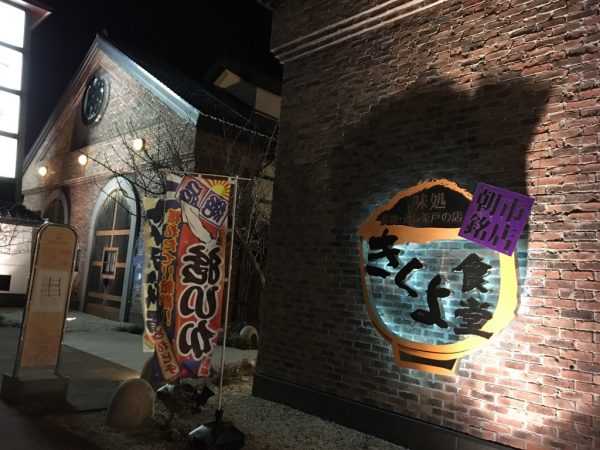
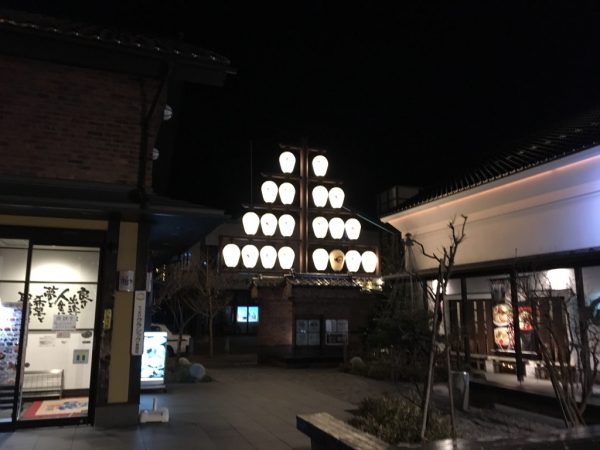
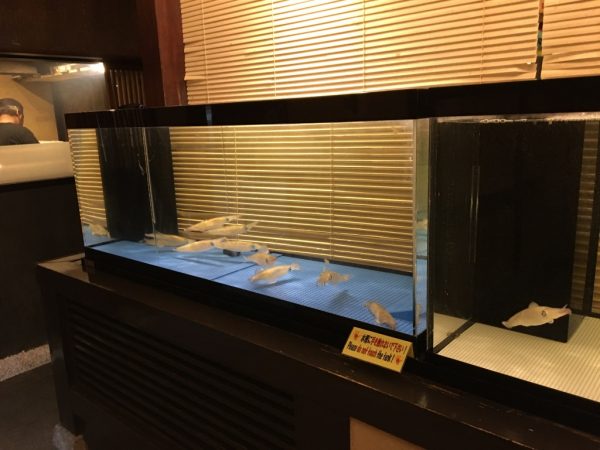
At the entrance, there was a squid preserve….
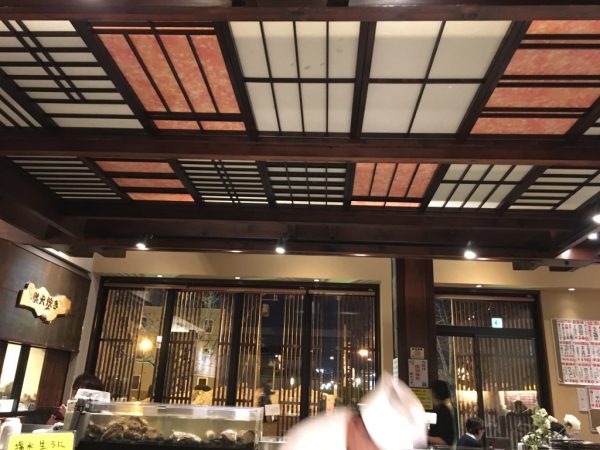
We were offered the seats at the counter. The interior was “traditional-like-modern” Japanese.
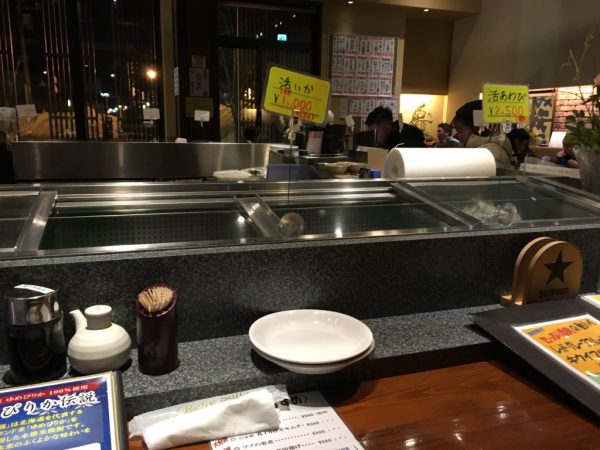

This is the page of Kaisen-dons in the menu.
I ordered a “okonomi-don with 3 toppings you like)” with Uni, ikra and scallop.
Aside from Kaisen-dons, there were many fascinating dishes on the menu. I think you can ask for an English menu (and just try to ask for a Chinese menu if you want. I’m not so sure about that). I ordered sautéed scallops with butter too.


My drink was a kind of Shochu (Japanese liquor) called “Inca no mezame” that means “the wake of the Inca”…
I don’t know the relationship between the shochu and the Inca empire in South America, but I ordered this because it’s made from potato, not sweet potato. It’s rare and for Japanese people, potato is Hokkaido’s thing.
My sautéed scallop with butter came first

Then my Okonomi-don with Uni, ikura and scallop served with the miso soup and pickles.

My friend chose shrimp, scallop, and ikura.

First of all, the sautéed scallop with butter was fantastic. Actually, unbelievably delicious.
And the kaisendon. I just want to say “Bravo”. Actually the tourists in Hokkaido like me easily think that the freshest fish are available at the shops in fish markets, but I realised it’s a wrong idea.
The creamy uni melted in my mouth, the ikura was so tasty, and the fresh taste of the scallop!
Besides, the price for the kaisen-don was 1780 JPY +VAT. Considering the cleanliness and the nice atmosphere of the restaurant, I found it rather good.

The neighbourhood was also good for walking around.
In conclusion: If you want to have the best quality of Kaisendon with cheaper prices, visit Hakodate.
I can recommend you all of the places that came up in this post for the quality.
However, I think you can have the same quality of kaisendon with cheaper prices in Hakodate than in Sapporo, or Otaru.
Note that the quality or the kind of fish you can eat depends on the season, and the weather as well. I want you to try as many kaisen-dons as possible in Hokkaido!