
Have you heard of the new Japanese emperor who succeeded his father’s position in 2019?
It was an irregular succession because his father (the former emperor) was still alive but decided to turn the title over to him in the previous year, then the Japanese government reluctantly approved of the request.
By the way,
But the British royal family is the most famous. And the scale of Queen’s land including Canada, Australia, New Zealand and so on, as well as the UK, is completely overwhelming.
The Japanese imperial family is just for Japan, which has a population of 120 millions and has a land size that’s a bit bigger than the Great Britain.
However, just for the length of the history, the Japanese imperial family is older than the British royal family by several hundreds years.
When I was in England, a few people asked me;
At first, I was discreetly shocked by that our imperial family is not so known….Is it better than having hostile people towards Hirohito due to the WW2…?
Anyway,
In the legend, the origin of them started in the 3rd century B.C., but it has never been proven scientifically.
The archaeological study shows that the giant tombs indicated that their ancestors were ruling the region, which is now so-called as Kansai (including Nara, Kyoto and Osaka), in the 5th century, and then they spread their control to further areas.
Some people were rather knowledgeable about the history in the 20th century; therefore they were not convinced that
Yes, aside from Okinawa and Hokkaido, which became parts of Japan in the 19th century, all of the countries or regions that Japan had merged/conquered or, maybe….invaded in the early 20th century became independent after Japan was completely defeated in WW2.
Actually, the “IMPERIAL” has nothing to do with the history of the 20th century, but it goes back to the early 7th century (to be exact, 607 A.C.).
- Until the middle of the 19th century, there were always an emperor and a practical king(shogun) at the same time
- The hereditary shoguns and emperors were always in Japan from the late 12th century to the middle of the 19th century
- Kamakura bakufu(shogunate) emerged in the late 12th century
- Muromachi bakufu
- Sengoku Period (Warring States period)- A Portuguese priest called Nobunaga (a lord from an ordinary countryside lord) “a king of Japan”
- After the assassination of Nobunaga, Hideyoshi (Nobunaga’s subordinate) acceded to power
- Tokugawa shogunate (1603-1867): the last shogunate
- Then, Japan stopped the seclusion and Meiji emperor became the leader in the 19th century
- The hereditary shoguns and emperors were always in Japan from the late 12th century to the middle of the 19th century
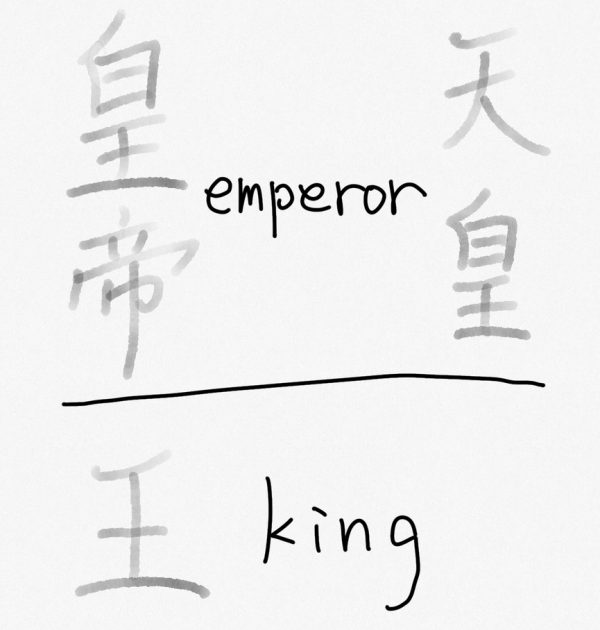
- An emperor or a King? This is just the translation :-皇, 帝=emperor, 王=king
Until the middle of the 19th century, there were always an emperor and a practical king(shogun) at the same time
When Japan opened the country to the world in the middle of the 19th century after more than 200 years of seclusion, Japan also became modernized – adopting Western things, especially modelling after France (for their fashion, foods and ideas), Germany(for their medicine, engineering) and England (for their protocols, manners and ritual things). The United States was already becoming an influencing country, so some Japanese people were dispatched there to import “modern ways” in Western sense.
The hereditary shoguns and emperors were always in Japan from the late 12th century to the middle of the 19th century
In the middle of the 19th century, Tokugawa shogunate fell and the last Shogun (the top of Samurai lords, as it were, the general) gave up its political power to the Meiji emperor and the new government.
So many people might get confused like…
Yes, that’s the point.
Kamakura bakufu(shogunate) emerged in the late 12th century
That is shogun vs the imperial family (and aristocrats in Kyoto).
Originally, Japan was ruled literally by emperors and their relatives; the aristocrats who made their daughters to the imperial court as the candidates of empresses, so the grandfathers (major aristocrats) of young emperors were practically ruling Japan. It lasted until the 12th century.
However, samurai gradually oriented people, thus obtaining the power in the late 12th century and the first shogunate (the practical government) was established in Kamakura City (90 minutes away by train from Tokyo, very far from Kyoto).
It can be said that this Kamakura bakufu was the government of samurais. Even though they were practically ruling the entire Japan, the title of shogun was significantly lower than hereditary emperors.
This bakufu lasted almost 150 years. During their time, the dominance of the imperial family and the aristocrats was practically losing. In the end, the bakufu had to interfere with the succession of the imperial family and it led to several conflicts among the imperial members and aristocrats. Because of that, the bakufu itself was losing its power as well and it caused the fall of the bakufu.
Muromachi bakufu
The second shogunate was established in Kyoto in the 14th century because they were also kind of aristocrats as well as samurai oriented, and were closely related to the imperial family. They took over previous bakufu by solving the conflicts caused by the succession issues of the Imperial family. There were roughly 2 streams of the descendants of the past 2 emperors (the 89th and the 90th and they were half-brothers).
As a result, one emperor, whom the Kamakura bakufu was not supporting, defeated the bakufu successfully.
Then, Ashikaga, who contributed to the victory over the conflicts, was allowed to establish a new bakufu called Muromachi bakufu in Kyoto.
It lasted until the 16th century when Nobunaga Oda expelled the last (the 15th) Shogun, Yoshiaki Ashikaga.
Sengoku Period (Warring States period)- A Portuguese priest called Nobunaga (a lord from an ordinary countryside lord) “a king of Japan”
It was still the time when Muromachi bakufu was ruling Japan, but in the late 15th century, the authority of the bakufu gradually became weaker in power due to battles or confusions.
Then, daimyos (samurai lords who were governing each region) started battles with each other to try to expand their territories. With some miraculous victories, Nobunaga Oda who had originally been only a lord of a small minor land became the most influential person in Japan. When he became a notable Daimyo after big battles, he was supporting the 15th Shogun, Yoshiaki Ashikaga. However, Nobunaga eventually expelled him from Kyoto and it was not over the battle. Yoshiaki was marching out of the shogunate court while feeling extremely insulted, and Nobunaga bowed with respect as he was sending him off).
Nobunaga even requested the emperor to give him a piece of the national treasure (a scent tree log) which had been kept in a safe for more than 100 years. And it was an incredibly impudent request for his original title. Superficially, the imperial family was by far the highest and Kyoto aristocrats still boasted their noble stock , so the messenger (noble person in Kyoto) was hesitant but they had to bear the samurai’s demand.
One Portuguese priest who was trying to introduce Catholicism in Japan at that time described Nobunaga as the “KING” of Japan, because even the emperor was at the mercy of him.
After the assassination of Nobunaga, Hideyoshi (Nobunaga’s subordinate) acceded to power
When Nobunaga was about to unify the entire Japan after the long-time Warring States period, he suddenly got attacked and killed by one of his subordinates, Mitsuhide Akechi. He was revenged 11 days later by another Nobunaga’s subordinate Hideyoshi.
It is still a mystery why Mitsuhide attacked his boss, although there are some hypotheses. Anyway, the revenger Hideyoshi subsequently succeeded to Nobunaga’s place.
Hideyoshi was not even from Samurai family. His father, Yaemon Kinoshita, was unknown – probably an ordinary peasant but later Hideyoshi tried to hide his actual biography, so there was no clear description of his early life. However, he got promoted dramatically by joining Nobunaga’s side in battles and gradually approaching Nobunaga.
He eventually became the most influential person as a minister at that time. His time is called as Azuchi-Momoyama period but it includes Nobunaga’s time.
After Hideyoshi’s death, another daimyo called Tokugawa was becoming more powerful and defeated Hideyoshi’s son in the end.
Tokugawa shogunate (1603-1867): the last shogunate
Ieyasu Tokugawa succeeded in obtaining the title “shogun” and then, he opened his own shogunate (bakufu), which lasted more than 240 years. And they were actually ruling Japan as the other two previous shogunate did, but this time was more stable and more controlled. During this time, Japan closed the country from other countries, which means foreigners were forbidden from entering Japan, but before that, several European countries were trading with Japan since Nobunaga was positive with getting to know Western cultures. However, Tokugawa bakufu considered those countries as threats of attempting to colonize Japan.
Only Dutch merchants and limited Chinese traders were allowed to come into Dejima port that was located near Nagasaki. It is quite far from Edo, currently known as Tokyo, where Tokugawa bakufu was located.
Why were the Dutch permitted while other Europeans were strictly excluded? My rough explanation is that they did not look so religiously influential. At that time, Christianity (especially Catholic was considered as a big threat) was strictly forbidden by bakufu even though Nobunaga rather protected Catholic priests from Portuguese. Because Tokugawa bakufu thought European countries were expanding their territories by using their religious power. They got their support after baptising them and that is what Tokugawa Bakufu was concerned about.
There is a story. In 1643, one Dutch boat had to land from a different port of Japan (the current Tohoku area – much closer to Edo <Tokyo> than the Dejima port) to avoid a storm that could have sunk them. They claimed that Dutch sailors had been allowed to have an access to any ports of Japan by Ieyasu (The founder of Tokugawa bakufu). However, the officials of that region suspected that they pretended to be Dutch merchants.
At that time, the major European language in Japan was Portuguese. Of course, very few people could speak it so there were only a few translators of Portuguese. Luckily, one of the Dutch sailors knew Spanish and he managed to communicate with the translator.
The lord of the region tried to test them to see if they were the priests or not by showing the portrait of Maria. Then, the merchants started spitting on it and said they could even break it. Finally, the lord was convinced that they did not try to sneak into Japan with a religious ambition and then, they were released.
The interesting thing is, the Dutch merchants (sailors) called the shogun “the Emperor” during the investigation.
Considering that Luís Fróis (one Portuguese priest) called Nobunaga “the King of Japan” in his book, the existence of the emperors in Kyoto was always ignored by European people at that time.
My high school history teacher once said this;
Of course, people cared about the existence of shogun, because its decisions were directly influencing on their lives.
Then, Japan stopped the seclusion and Meiji emperor became the leader in the 19th century
In the middle of the 19th century, a delegation ship from the US, which was led by Perry arrived in a port (close enough to Edo <Tokyo>) to negotiate with Japan on the opening the country. It triggered several conflicts between opening party and expelling aliens party, but after all, Japan ended up opening the country to the world.
Japan adopted Western ways to get modernized (1867~)
It means that the emperor regained its power from shoguns as the leader of Japan for the first time in nearly 700 years….
Before that, in the ranks, emperors were always the highest and shoguns were placed below the imperial family, but practically it was the shogun who was ruling Japan.
However, it was the government led by Prime Ministers who was practically controlling Japan.
The government symbolized the emperor as a sacred existence and took advantage of it to control the people’s loyalty for the emperor.
After World War 2 (1945~)
In 1945, Japan was defeated in WW2 and became democratic with GHQ (Allied Occupation 1945-1952). Showa emperor, known as Hirohito (a grandson of Meiji emperor), declared that he was the same as everybody else and now, the emperor and its family are just considered as the symbol of Japan’s traditional or cultural heritage.
They never interfere with the politics or the laws anymore.
An emperor or a King? This is just the translation :-皇, 帝=emperor, 王=king
Anyway, when Japan finally stopped the seclusion in the 19th century and started following Western type of modernization, the Meiji emperor (the great-great-grandfather of the current emperor) replaced the shogun’s position as well as the sacred symbol. They always had a thing for the ancient times.
In fact, the imperial family got the position as a ruler back after 700 years.
Then, why was it translated as “emperor” instead of “king” in the English language and other European languages?
Japanese title “Tenno” is written by 天皇.
At that time, there was still a Chinese dynasty(Qing) in China, and the emperor was written by 皇帝.
The pronunciations are different between Japanese and Chinese, but the spellings are the same (to be exact, both countries simplified the letters differently in the 20th century, but in many cases we can recognize each other’s simplified ones).
There were also kingdoms in neighboring countries like Joseon dynasty in Korea and Ryukyu kingdom in Okinawa prefecture.
The kings in those kingdoms were written as 王, and a kingdom is written as 王国 in kanji (Chinese letters).
You could notice the common letter between 皇帝 and 天皇. 皇 is common. And 天皇 is the specific title of Japanese emperor, but Japanese emperor was translated to an emperor in English (un empereur in French) because of 皇.
Besides, in the long history of Japan, the emperors were often called as 帝(mikado) as well as 天皇(Ten-noh). Did you notice that the letter is the same with the second one of 皇帝?
It was also one of the factors why the Japanese Ten-nou or mikado was translated as emperor.
Aside from the Asian countries, we use those kanjis for the reigns in Europe or other regions.
Here are the examples
| France (Maison de Bourbon) | ex. Louis XIV(whatever) | 国王 |
| France (Empire Français) | Napoléon Bonaparte | 皇帝 |
| Holy Roman Emperor | ex.Charles I | 大帝 |
| Holy Roman Emperor |
Francis II |
神聖ローマ皇帝 国王(as king of Hungary, Croatia and Bohemia) |
| Russian Empire | Peter the Great | 大帝 or 皇帝 |
| Russian Empire |
Catherine the Great |
女帝(女 means female),皇帝 |
| British Empire | Queen Victoria/ | 女王、インド皇帝/女帝 (as Empress of India) |
| Ottoman Empire |
Suleiman the Magnificent |
皇帝 |
Why did they entitle themselves as 天皇(Ten-noh)/帝(Mikado)?
This is the point of this post, finally…(too long to get to the point? sorry!)
Actually, they were called as 大王(Oo-kimi, 大 means great or big) until the middle of the 7th century.
At that time, Chinese Empire was an extremely great existence in Asia, and they did not know the Western world but India was recognized as the place of Buddha.
China was by far the most advanced country, so Japan had to learn almost everything from China by dispatching intelligent officials there. It was the 5~6th century when Japan imported Kanji (Chinese letters) .
“天皇 of the east sovereign with respect to 皇帝 of the west sovereign”
Of course, the Chinese emperor did not admit the equality of Japan and China, but Japan was lucky enough to be far away from China with the sailing technology in the 7th century.
Furthermore, China was busy with the war against Goguryeo that was a kingdom of Korean Peninsula. It was much more serious for China because Goguryeo adjoins China on the same continent while Japan was completely isolated geographically.
As a result,
So Japan has continued to use “天皇” for the title of reign since then!!
Japan is often described as “modest” or “humble”, but not always, so indeed.

