If you have a plan to travel to Japan, be ready for the situation in which your English is NOT understood at all.
Although English is a mandatory subject in almost all secondary schools in Japan*, I assume that less than 5% of Japanese people are pleased to speak English when they encounter tourists who are in trouble due to language barriers.
Most Japanese people want to give a hand, but many of them have phobia of speaking English at the same time.
*In some private Catholic schools, French can be opted instead, but they still study English to some extent.
Japanese are familiar with many English words but they pronounce those words with Japanese sounds
Japanese people are not confident in speaking English, but that does not mean they don’t understand English at all.
There are many words adopted from English or other European languages in modern Japanese
In fact, Japanese people are familiar much more with English vocabulary than with other countries because many words that stemmed from English are used in daily Japanese conversation.
When Japan stopped its seclusion and opened the country to get modernized in the 19th century, plenty of Western stuff were installed into Japanese people’s lives, and Western words mainly from English, French and German got settled in Japanese language.
However, the usage of Western words in Japanese is not only for Western specific things but also expands to general things, whereas Japanese words exist just because Western words sound more fashionable.
When I was in Thailand, I was surprised that basic words, like “orange”, “banana” or “pineapple”, were not understood by waitresses. I guess that most Japanese waitresses would understand if you simply just say the words. That is, as long as you don’t put them in a long sentence.
Thailand is full of those tropical fruits, so they call them in their own language, of course. But Japanese people are also accustomed to English words even though there are equivalent Japanese words as well.
For example, I think 100% of Japanese people know “car” when we usually say “kuruma” or “jido-sha” for that. Somehow we call a car “kaah(カー)” in some situations. For example, we say “Eh/koh/kaah(エコカー)” for echo-friendly vehicles. Apparently Eh/koh/kaah is from the English “eco-car” although the word is not used in English speaking countries.
There are many “Wasei (made in Japan) Eigo (English)” in Japanese, like “eco-car”.
Anyway, Japanese people are familiar with many basic English words, and they put them into a Japanese sentence very often.
Japanese people perceive any words with “one consonant + one vowel” system of Japanese language
However, Japanese pronounce those ENGLISH words in Japanese accent. I think it’s not just the accent but also the syllables.
If you know some Japanese words like Honda, Toyota, Sushi, Tempura, Tsunami or Yoko Ono, you could notice the system of “consonant + vowel” or just vowels.
See below to make sure the system.
| alphabets | katakana | katakana and alphabets | kanji (Chinese character) |
| Honda | ホンダ | ホ=HO, ン=N, ダ=DA | 本田 |
| TOYOTA | トヨタ | ト=TO, ヨ=YO, タ=TA | 豊田 |
| Sushi | スシ | ス=SU, シ=SHI | 寿司/鮨 |
| Tempura | テンプラ | テ=TE, ン=M(N), プ=PU, ラ=RA | 天麩羅 |
| Tsunami | ツナミ | ツ=TSU, ナ=NA, ミ=MI | 津波 |
| YOKO* | ヨウコ | ヨ=YO, コ=KO | 洋子 |
To be exact, “Yoko” should be “Youko” to match ヨウコ(ウ is usually written with a U), but then you would pronounce it like “Yuh-ko”, so it is an error. Yuuko (ユウコ) is also a common name for Japanese women, but it is usually written as Yuko instead of Yuuko. As such, sometimes “i, u, o” of Japanese names are dropped in alphabet.
So there is the word “オレンジ” that is pronounced “Orengee” in Japanese. Apparently, it means “orange”. You can notice that オレンジ consists of 4 characters. Therefore, the word has 4 syllables while “orange” in English has only 2 syllables.
Any words from other countries (except the words written in Chinese characters) are usually written in KATAKANA that consists of 50 characters and are just phonetics.
Japanese language is completely different from Chinese…
Many people asked me if I speak Chinese because Japanese looks the same with Chinese language for them (European language speakers).
How come you think they are similar just because of the common characters?
If your first language is English, I want to ask you this:
Both languages are written using the letters of the alphabet. Of course some English native speakers also speak Italian, but they must have devoted themselves into it for years.
That’s the same for Japanese people with Chinese. We could recognize some phrases due to the kanji characters that share the same meaning. Also because many Chinese words were adopted by Japanese, just like there are many English words that stemmed from the Latin language.
However, the language structures (grammar, or the word order in a sentence) are quite different between Japanese and Chinese.
In high school, students learn the “interpretation” of ancient Chinese poetry
I found that the word order like subject verb objective in Chinese is much closer to English than Japanese when I was learning the interpretation of Chinese ancient poetry in high school.
Japanese students don’t learn how to read them aloud, but they learn the sentence structure and the meanings of phrases briefly in high school. It’s like “this letter should be subject…and these 2 letters express that…Ah! This is a negative sentence…”.
That means, in class, students read (interpret) Chinese sentences like codes, but it’s not a practical Chinese lesson at all. In fact, it’s impossible for high schools to offer students Chinese practical classes.
Generally, students who major in Chinese language have to study it so intensively at Universities.
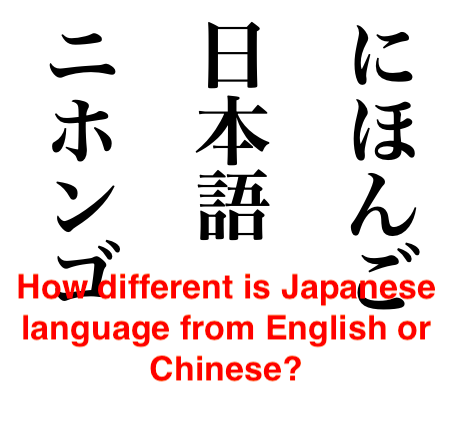
How are the 2 kinds of phonetic characters, as well as Kanji characters, used in Japanese ?
We have 2 kinds of phonetic characters called HIRAGANA and KATAKANA, and we also have Kanji. They were originally invented for women in medieval times so that they could express the spoken language phonetically. Kanji characters (Chinese characters) are not phonetic, but are numerous (5,000) and complicated, so they wanted something more convenient and easier.
Then gradually, hiragana characters were installed to complement Kanji in one sentence.
And, here is the Japanese translation.
In the sentence, the letters in red are Kanji and the ones in blue are katakana, and the others are hiragana.
As such, we mix those 3 kinds of characters in one sentence at the same time.
Since those 2 phonetic letters only have 50 characters each, while there are about 5,000 kanji characters, small kids learn hiragana first, then katakana to start reading and writing.
So the sentence above can be written in hiragana and katakana like this.
Even 6-year-old kids can read the sentence. Then, why do we continue to using kanji characters that are so complicated?
Actually, a sentence written only in hiragana (and katakana) is harder for adults to grab the meaning at a glance. Each kanji character has a meaning, so we are used to understand the sentences or phrases based on the kanjis used.
Furthermore, there are so many homonyms in Japanese language. Those homonyms are written the same in hiragana (or katakana), but differently in kanji.
So, sentences written only in hiragana look confusing. Small kids only read simple Japanese, but they have to study 1,000 kanjis in primary school and eventually, 3,000 till senior year of high school to adjust themselves to the adult level of Japanese (reading newspapers, for example).
Oh, we have to memorize not only 3,000 characters but also multiple usages and pronunciations for each.
I will make another post to explain more about it. In the next post, I will also write my idea about why Japanese generally LOOK so bad at English or any foreign languages.