
Yes, you should make a plan to come to this wonderful country.
Japan?…but I’m not keen on anime, I don’t like raw fish, anything else? Oh, I saw the crowded districts of Tokyo…I hate that. I want to relax on vacation. Besides, I heard that Japan is expensive.
Do you think of Japan like that?
If so, you are definitely wrong.
- Japan is actually very diverse. From snowy regions to tropical areas.
- Japan is not expensive anymore. As a tourist, it should be cheaper than any other developed country.
- You are in a privileged position, ANA and JAL offer you domestic flight tickets for promotional prices
- So many variations for Japanese dishes, 47 prefectures have their own gourmets.
- There are many types of historical places in Japan
Japan is actually very diverse. From snowy regions to tropical areas.
I don’t know why so many people believe that Japan is small. Actually, many Japanese people also believe so. I guess they just compared Japan with the US for a long time after the war. And there are also China and Russia nearby.
For the people who vaguely think of Japan as a small country, I assume some people mix up Japan with Hong Kong or Singapore? It’s so funny, but there are some reasons why I guess so. One British guy believed that the Chinese language is spoken in Japan. One Spanish guy said he wanted to go to the tiger balm garden in Japan. I was stunned.
When I was reading through an article about how two Japanese boys got silver and bronze medals respectively for snowboarding halfpipe in the Sochi Olympics, I found a comment like this, “Why are Japanese so good at snowboarding? It never snows there!” ……
…………….
well, it snows in Japan.
Japan has already held 2 Winter Olympics games. Sapporo in 1972 and Nagano in 1996.
Even in Tokyo, sometimes it snows. Not every year recently, but sometimes the snow lies about 50 cm on the ground in Tokyo, so I remember my primary school sometimes releasing us into the playground from the classroom.
And there are many snowy regions in Japan. Hokkaido is a famous example (Sapporo is the capital of Hokkaido). Actually the depth of the accumulated snow can be 3 meters high in some areas. Aside from Hokkaido, there are many snowy regions in Japan. So the two medalist boys had a wide range of places for practicing snowboarding (It’s one of the most popular sports among Japanese).
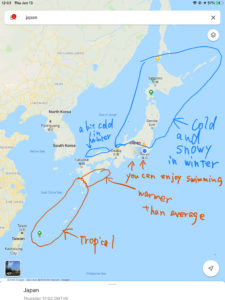
On the other hand, you have many opportunities to enjoy marine sports in Japan. Okinawa boasts its extremely beautiful sea. Actually I am addicted to going snorkeling there. I have never been to Kagoshima, but it also has a tropical climate.
But for most regions of Japan, the climate is moderate. And the four seasons have affected Japanese culture greatly. Have you ever heard of Haiku or Waka? This is the style of traditional short poetry in Japan, in which you have to include a word that describes the season. So you can see how important the seasons are to Japan.
Make sure you enjoy the unique pleasures of the seasons during your trip, One experience is never enough!
Japan is not expensive anymore. As a tourist, it should be cheaper than any other developed country.
So many people believe that Japan is still expensive.
It was more than 20 years ago that Japan was more expensive than other developed countries.
Yes, when I visited NYC in 1997, I didn’t find the city particularly expensive. However, I found that NYC was far more expensive than Tokyo in 2012. The same thing happened in Europe.
Yes, Japan has had deflation for a long time. It has lasted for 25 years, and it is still going on.
The prices of things are the same or even cheaper than 25 years ago in this country, it’s crazy. Of course the same phenomenon is seen in our incomes. But other countries have had normal inflation, so, for you, Japan has become much cheaper than in the past relatively!
Trust me, you would be amazed by the cost of dining out. If you are practical enough to ignore the posh names like Ginza (one of the poshest districts), you can buy very tasty sushi from conveyer lane canteens for 15-30 USD. Please do not imagine the sushi sets in your country.
For other type of foods, you can have a bowl of Ramen noodles for 6-8 USD, and so on.
You are in a privileged position, ANA and JAL offer you domestic flight tickets for promotional prices
I am envious of you. Somehow you can benefit from travelling around Japan simply because you are not a resident of Japan.
Japan is now trying to attract more and more tourists, so you are encouraged to travel around Japan. You can get JR (including Shinkansen), JAL, and ANA tickets with far cheaper costs than Japanese people (If you are living in Japan, you cannot take advantage of this regardless of your nationality).
For example, now you can buy a ticket from Tokyo/Haneda to Ishigaki island in July -a remote island off Okinawa, and one of furthest available destinations for 92 Euros (it’s like 11,250 JPY) of ANA while the early discount ticket costs at least 23,000 JPY for Japanese.
You should grab this chance to explore Japan at low cost!!
So many variations for Japanese dishes, 47 prefectures have their own gourmets.
The only Japanese cuisine you can name is Sushi? Oh, Japan has really really diverse gourmet culture.
First, as described above, Japan is vast and each region has its own specific foods. There are 47 prefectures and even in one prefecture, there are regions that have different tastes and styles of cuisines.
Let’s take Ramen as an example. I had a college classmate who came from Fukuoka city which is located in Kyushu. Fukuoka boasts its pork stock soup Ramen. Perhaps now you can often find the canteens with the same style outside Japan, as a trend. This is called Tonkotsu, and is now nationwide and international and believed to be the standard for Japanese Ramen in big cities like NYC, London or Paris. This was not the case when I met my friend at University (that’s more than 20 years ago!).
“Oh, is this that Tonkotsu from Fukuoka…? a bit greasy and smelly….” my first impression was like that. But then, I became fascinated with the thick texture and the taste of the soup with its thin straight noodles.
On the other hand, he described to me his impression of Ramen with soy sauce soup, which is always standard: “I was startled to see the spiral noodles here at first, but I like the taste, less greasy”
One TV program “Kenmin (Ken: prefecture+ Min:people) show” introducing each region’s specialties every week. In the program, several celebs try the specialties and talk about their impressions. “Wow, I didn’t know this cuisine, and I couldn’t imagine how it tasted, but it’s really good!!!” Or something like that.
And the TV program has a 12 years history now. You can see countless “specialties” exist in Japan.
Besides, Japan adopted foreign cuisines mainly western ones and sometimes created new ones out of these.
In the middle of the 19th century, Japan stopped being isolated (only Dutch merchants had been allowed to do trading) from the world, and then started adopting European fashions and customs, along with European-style imperialism.
That’s why Western food cultures are naturally at home in Japan. Thus banquets at the Imperial Court have served French cuisine as a tradition since the late 19th century.
Especially for the wealthy, luxurious hotels focused on serving French cuisine in the late 19th century, and so many chefs were trained very strictly.
Actually, the history of western foods among Japanese people is longer than that of Chinese. Somehow western cuisines rapidly became popular among ordinary people in cities throughout Japan.
So I saw many scenes like those seen in novels of the late 19th and early 20th centuries, in which students from countryside are embarrassed at Western-style dinners held at their posh classmates’ homes .
And there are some dishes deprived from Western foods, for example, Ome-rice.
This is one of the nostalgic “mother’s cooking” dishes in Japan. Apparently, it began as an omelette, specifically, chicken rice with ketchup covered by an omelette.
The dish was allegedly born in a casual “You-shoku (meaning western style dishes)” canteen in Okasa in 1930’s.
And another thing, there is a cake called “mille-crêpe“, apparently stemmed from “mille feuilles”. Mille-feuilles itself is also popular but mille crêpe is a cake with many layers of crêpes.
Oh, there is also a spaghetti dish called “Neapolitan” , that also comes from the menus of traditional “You-shoku” canteens maybe since the 1950’s – but does not exist in Naples (lol).
As such, you can enjoy various styles of Western cuisines in Japan as well. This is also part of Japanese food culture.
There are many types of historical places in Japan
Japanese history is a bit complicated.
Don’t casually ask a Japanese person around you “Why emperors and Shoguns existed at the same time?” unless you are really interested.
That’s too complicated to answer. But yes, there were always two types of rulers in Japan from the late 12th century until the middle of 19th.
In the Nara period, Japan learned and imported many things from China, which was then a far more advanced empire. In the late 8th century, the capital was moved to Kyoto, and Japan started developing its own unique civilization. During the Heian period, although Japan was nominally ruled by the emperor, powerful aristocrats monopolised actual political power by sending their most beautiful daughters to the court to have “a crown prince grandson”. But the time ended in the late 12th century, and the Samurai era started.
Superficially, the extended Imperial family and aristocrats still held higher positions than the Shogun (the top general of the Samurai). However, in reality, the Shogunate ruled Japan.
The Shogunate changed a few times. The last Shogunate was that of “Tokugawa”, which ruled for more than 300 years. When it collapsed, Japan was forced to open up to the world.
This complicated structure of the country produced the various types of culture we find today.
The castles of Samurai lords have a different style to the buildings of Kyoto, as you will see on your travels.
So these things came to mind as reasons for you to visit Japan.
You don’t have to be keen on anime or video games. Japan has attractions for people with all sorts of interests and hobbies.
Why don’t you make a plan right now?