Even though Japanese foods are now becoming universally popular and its modern culture may not look very different to other countries, Japan is still unique, and there are many specific rules and concepts especially relating to Japanese traditions.
Today, I want to pick up on some of the things that many non-Japanese people have the wrong ideas about.
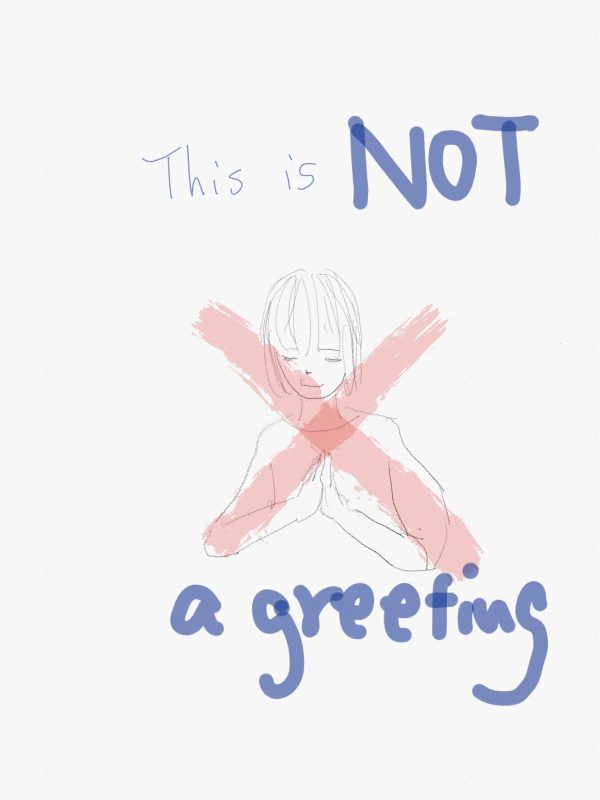
We do NOT put our hands together to greet.
Well, it’s not so annoying to be greeted by Westerners putting their hands together, but I do feel a little awkward when it happens to me.
This is because it’s not our style. I guess it’s often seen in Thailand.
One American guy was surprised when I shattered what he had believed for a long time, saying “But I saw some Japanese people doing that to each other!!” He was working in Manhattan, so he had many opportunities to observe Japanese business people there.
I easily imagined what kind of occasions he had witnessed.
That’s not a greeting.
Actually, what he had probably witnessed was the moment a person begs another person for something difficult or shows appreciation or is extremely grateful for what another person has done.
For example, asking a client to choose his or her company to meet their sales goal. When I was working for a company as a marketer, I was in charge for promotions, so I was seeing some sales representatives from different ad agencies.
One sales representative was begging me to choose his company for a promotional campaign over his competitors, so he did that gesture to me.
There are basically two ways to beg in this situation, and the other is actually bowing down very deeply…and in many cases, it’s more sincere and polite than putting your hands together.
When the sales rep. did that to me, I found it slightly offensive because I felt like he did not respect me enough as his client because I was young and female.
That’s seems very obscure, but in my opinion, that’s the gesture to use with people that you can casually speak to. In a formal business situation, I felt that he was being impolite.
So it’s often seen in a family, close friends, or colleagues.
For example, college kids do that to their parents saying “Please give me some extra money…I’m broke!”
Or, before an exam, a student might do that to his/her hard-working friend saying “Please let me make a photocopy of your notes!”
Japanese people don’t think deeply about it but this spontaneous behaviour is obviously from the practice of Buddhism, so as it were, that’s kind of a play like “You are my Buddha if you do me a favour!”
Of course normal living people are not Buddha, so that’s why it’s like a bit kidding and very casual behaviour.
Not insulting, but not very polite.
And let me repeat, it’s not a greeting in Japan. So it’s just odd for you to do that to a waitress in a restaurant…
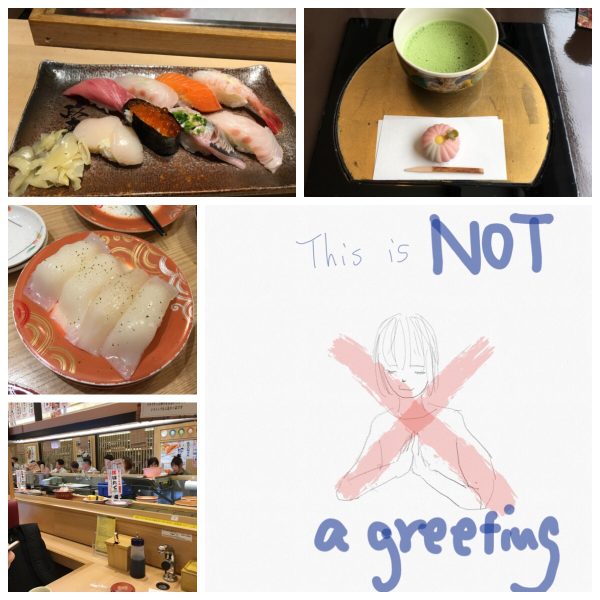
Do NOT put too much soy sauce on your sushi if it’s fresh…
This is another thing I often care about…honestly!
First of all, sushi is not formal cuisine at all, actually it was originally Japanese fast food. So no snobbish table manners are required.
Sushi is now worldwide famous as Japanese food and many people see it as a rather expensive thing.
But there are many ranks for the quality of sushi and types of places you can buy it, so the cost differs from 500 JPY (app. 4€) for a basic sushi set from a supermarket to 50,000 JPY (app.410€) for a dozen pieces of sushi from a very expensive sushi bar. To be honest, I am not quite sure about the most expensive place… I heard that people paid 100,000 JPY for one person’s course in an upmarket sushi bar in the poshest district in Tokyo in the late 80’s… but I suppose it’s just a crazy phenomenon of the Japanese bubble economy.
Anyway,
Nowadays you do not have to spend so much money on fresh sushi in Japan. Thanks to the severe competition caused by the economy and Japanese long term deflation, you can get very fresh and tasty sushi at “Kaiten-zushi” canteens at a good price (Sushi is sometimes pronounced zushi in one phrase combined with another word).
Kaiten-zushi is literally “rotation sushi” and it was originally considered as a budget place, not very good quality sushi, but a good place for a family with small kids. But nowadays, many kaiten-zushi canteens offer very a high level of fish, so you can have very fresh sushi for reasonable prices.
Do not take your sushi apart
I guess there are some different concepts between other countries and Japan about how you eat food at restaurants. When I dine out in a decent French restaurant, I must show the most respect to my companions and to other diners by behaving in an appropriate way.
On the other hand, in Japan it is most important to show respect to the chefs and the food itself. For example, it is rude to leave food on your plate, it disrespects the animals or vegetables that were used to create the dish.
That might be odd to Western people and…perhaps Chinese people.
In Japan, professionals in traditional fields are highly respected, so are sushi chefs. Many people wonder why sushi chefs have to be highly skilled for just combining rice and sliced raw fish…but in very expensive sushi bars like the one the former American president Obama visited, only the chefs who have gone through 10 or more years training can prepare sushi. They also have a strong connection with the local fish market & suppliers and have a very good eye so that they can get the best fish every day.
So…you can eat the sushi from supermarkets or cheap shops as you like, and in many kaiten-zushi canteens, you don’t have to care how you look (they are too busy to observe you!), but in traditional sushi-bars or Japanese restaurants, please do NOT take apart your sushi before you eat it.
You should eat one piece in one go.
Sushi chefs need many years to acquire the skill of preparing the rice with vinegar and combining it with sashimi. The perfect combination is thoroughly calculated. It’s a kind of culinary art and you need to eat the sushi in one go to fully appreciate the taste.
The way that the sushi is eaten is very important. Sushi chefs might watch the customers and could be offended if the beautiful sushi that they prepared is pulled apart or not eaten in one go. For this reason, it is better to take children to kaiten-zushi places instead of traditional places.
I don’t care if you want to use a knife and fork for most Japanese foods, but please do not use them for sushi.
With a knife and fork, you cannot avoid breaking apart the sushi. If you are not good at using chopsticks, then you can use your fingers. Every sushi bar offers you a hot towel to clean up your hands.
Do not put too much soy sauce on your sushi and do not soak the rice to soy sauce!
I also noticed that many non-Japanese people use too much soy sauce on their sushi!
If it’s from supermarkets or cheap takeaway chains, the quality of sashimi is not so good, then you need to diminish the smell or taste with soy sauce,
But if the sashimi is very fresh, you must not do that. Then you will not know the difference between your fresh one and a supermarket one. The taste is the same…just soy sauce.
And you must not soak the rice part in the soy sauce because then the rice will collapse.
In some places, the chef will paste a specific soy sauce onto the sushi depending on the kind of fish before serving you, then you don’t have to worry about it!
So these are the major points I would like you to know this time…if another thing comes to my mind, I will post!